By ChangeDigitally Team | Category: Dynamics 365 and ERP
Executive Summary
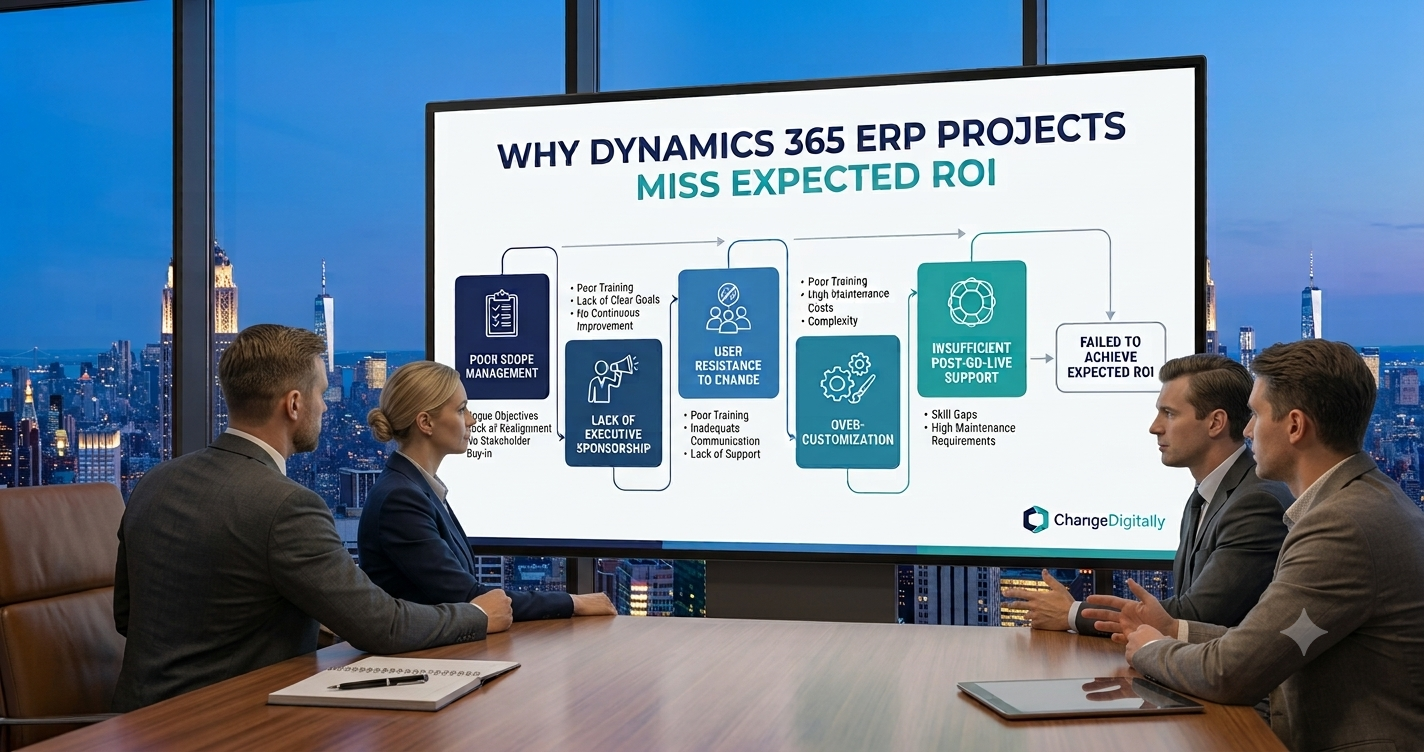
Microsoft Dynamics 365 can provide a strong platform for finance, supply chain, commerce, projects, and operational management. Yet some programs go live without delivering the expected Return on Investment (ROI). The usual explanation is that the software failed. In practice, underperformance more often begins with unclear business outcomes, fragmented ownership, weak governance, unnecessary customization, poor data readiness, inadequate testing, and limited adoption.
An Enterprise Resource Planning (ERP) program creates value only when technology, processes, data, people, and management decisions change together. Organizations that treat implementation as a technical installation may complete deployment but still preserve the inefficiencies they intended to remove.
This article presents an executive diagnostic for identifying why Dynamics 365 programs underperform and how leadership can recover value.
The ROI Gap Starts Before Configuration
Expected benefits are often described broadly: better visibility, improved productivity, stronger controls, faster reporting, or lower operating costs. These ambitions are reasonable, but they are not yet measurable benefits.
Before design begins, leadership should define a limited set of outcomes, establish baselines, assign benefit owners, and agree how results will be measured after go-live. Without this discipline, the program may deliver features while the organization cannot demonstrate value.
1. Weak Executive Ownership
ERP changes how functions make decisions, execute controls, and share information. These are management questions, not only system questions. When sponsorship is ceremonial, cross-functional decisions remain unresolved, scope expands, and business teams defer ownership to Information Technology or the implementation partner.
Effective sponsors set priorities, resolve conflicts, protect critical resources, and hold benefit owners accountable. Microsoft’s implementation guidance similarly emphasizes vision, business drivers, success metrics, roles, resources, and collaboration between business and technology teams.
2. Treating ERP as an Information Technology Project
Technology teams can govern architecture, environments, integrations, security, and release management. They cannot independently redesign finance, procurement, inventory, production, order fulfillment, or project operations.
Business process owners must define the future way of working, approve design choices, accept controls, and own adoption. Where process ownership is weak, workshops become requirement-collection sessions rather than transformation decisions.
3. Uncontrolled Customization
Customization may be justified when it protects a genuine competitive capability, legal requirement, or critical operational need. It becomes destructive when every legacy preference is recreated in the new platform.
Excessive extensions increase design effort, testing scope, support dependency, and upgrade risk. A stronger governance model requires each customization to state the business problem, measurable value, standard alternatives, recurring ownership, security effect, and lifecycle cost before approval.
4. Poor Data Readiness
Data migration is frequently planned as a late technical work stream. However, duplicated customers, inconsistent items, weak units of measure, incomplete dimensions, invalid addresses, and unclear ownership can undermine reporting and operations from the first day.
Data readiness should begin during discovery. Data owners should approve scope, cleansing rules, mapping, reconciliation, cut-over responsibilities, and post-migration controls. Multiple rehearsal migrations are normally necessary for complex programs.
5. Unrealistic Scope, Timeline, and Budget
Compressed plans may appear commercially attractive but can move unresolved work into testing, cut-over, and hypercare. The result is not faster transformation; it is delayed decision-making and concentrated operational risk.
Executives should challenge plans that assume immediate availability of key users, near-perfect source data, minimal design debate, low integration complexity, and limited change impact. A credible plan includes:
-
Decision time
-
Business validation
-
Data rehearsals
-
End-to-end testing
-
Training
-
Cut-over rehearsal
-
Stabilization
6. Inadequate End-to-End Testing
Passing individual configuration tests does not prove that the operating model works. Value depends on complete business scenarios across roles, companies, warehouses, integrations, controls, and reports.
Testing should include process integration, security roles, data volumes, interfaces, printing, reporting, exception handling, performance, cutover, and operational recovery. Business owners should approve acceptance criteria and unresolved defects based on business risk, not only technical severity.
7. Training Without Adoption
User training explains how to perform tasks. Adoption ensures that people understand the new process, responsibilities, controls, and expected behavior. A training schedule alone does not address resistance, role changes, shadow systems, or inconsistent management reinforcement.
Adoption requires:
-
Stakeholder analysis
-
Role-based learning
-
Super-user networks
-
Clear operating procedures
-
Leadership communication
-
Usage monitoring
-
Post-go-live coaching
8. Benefits Stop Being Measured at Go-Live
Go-live is a technical milestone, not the conclusion of the investment case. Many programs close when the system becomes operational, while benefit targets remain unowned.
Leadership should run a structured value-realization cycle for at least the first two or three reporting periods and then at agreed intervals. Measures may include:
-
Financial close duration
-
Inventory accuracy
-
Order cycle time
-
Production adherence
-
Procurement compliance
-
Manual journal volume
-
Forecast accuracy
-
Service level
-
User adoption
Warning Signs for Leadership
The program may be drifting toward lower ROI when:
-
No agreed baseline exists for expected benefits.
-
The steering committee receives status reports but does not resolve decisions.
-
Business process owners attend workshops but do not approve future-state processes.
-
Customization grows without business cases or lifecycle-cost review.
-
Data cleansing has no named business owners.
-
Testing focuses on modules rather than end-to-end scenarios.
-
Training is measured by attendance rather than capability and usage.
-
Go-live readiness is based primarily on schedule pressure.
-
Post-go-live support has no benefits dashboard or adoption measures.
A Practical Recovery Framework
Recovery should begin with an independent fact base rather than another large redesign. A focused assessment can be organized into six steps:
-
Reconfirm outcomes: Translate broad ambitions into measurable operational and financial results.
-
Assess program health: Review governance, process design, scope, architecture, customization, data, integrations, testing, security, cutover, adoption, and support.
-
Prioritize value leakage: Identify the small number of issues causing the greatest operational cost, risk, or delay.
-
Stabilize before optimizing: Resolve business-critical controls, data, performance, and process failures before launching new enhancements.
-
Reset ownership: Assign accountable business owners for processes, data, adoption, and benefits.
-
Govern a value roadmap: Sequence corrective actions and enhancements against measurable benefits, dependencies, and capacity.
Executive Checklist
Before approving the next phase, leadership should be able to answer “yes” to the following questions:
[ ] Are the expected benefits measurable, baselined, and owned? [ ] Are business process owners authorized to make cross-functional decisions? [ ] Is standard functionality the default design preference? [ ] Does every material customization have an approved business case and owner? [ ] Have data quality, migration, and reconciliation been rehearsed? [ ] Has the organization tested complete business scenarios and exceptions? [ ] Are users prepared for process and role changes, not only system transactions? [ ] Is cutover governed by objective readiness criteria? [ ] Will benefits and adoption be measured after go-live? [ ] Is there a controlled roadmap for stabilization and continuous improvement?
ChangeDigitally Perspective
Dynamics 365 is rarely the sole cause of poor ERP outcomes. The platform exposes the quality of the decisions surrounding it. Strong programs connect business outcomes, process ownership, disciplined architecture, clean data, realistic delivery, rigorous testing, adoption, and benefit realization.
Organizations do not recover ROI by adding more features indiscriminately. They recover it by clarifying value, reducing complexity, and restoring accountability.
Discuss Your ERP Initiative
Is your Microsoft Dynamics 365 program underperforming, experiencing delivery risk, or struggling to demonstrate business value? ChangeDigitally can assess program governance, process alignment, data readiness, solution complexity, adoption, and benefit realization to identify practical recovery actions.
Contact us at: info@changedigitally.com or call us at +1 (937) 405-5593 or +1 (403) 926-7615